

Welcome to the Video Store Podcast.
As the 1960s rolled into the 1970s, something changed in Hollywood. Movies got bigger. Louder. More chaotic. And sometimes… they were a total disaster, in the best way possible.
These were practical, physical, dangerous productions, massive sets, real stunts, and ensemble casts packed with stars who weren’t guaranteed to make it to the end.
The disaster movie wasn’t born in the ’70s but it peaked there. Airplanes in crisis, cities collapsing, ships overturning, skyscrapers burning.
This week, my picks come from the golden age of disaster movies as we look at four of my favorite disaster movies that still hold up, and that showcase exactly why the 1970s did the disaster movies better than anyone else ever has.
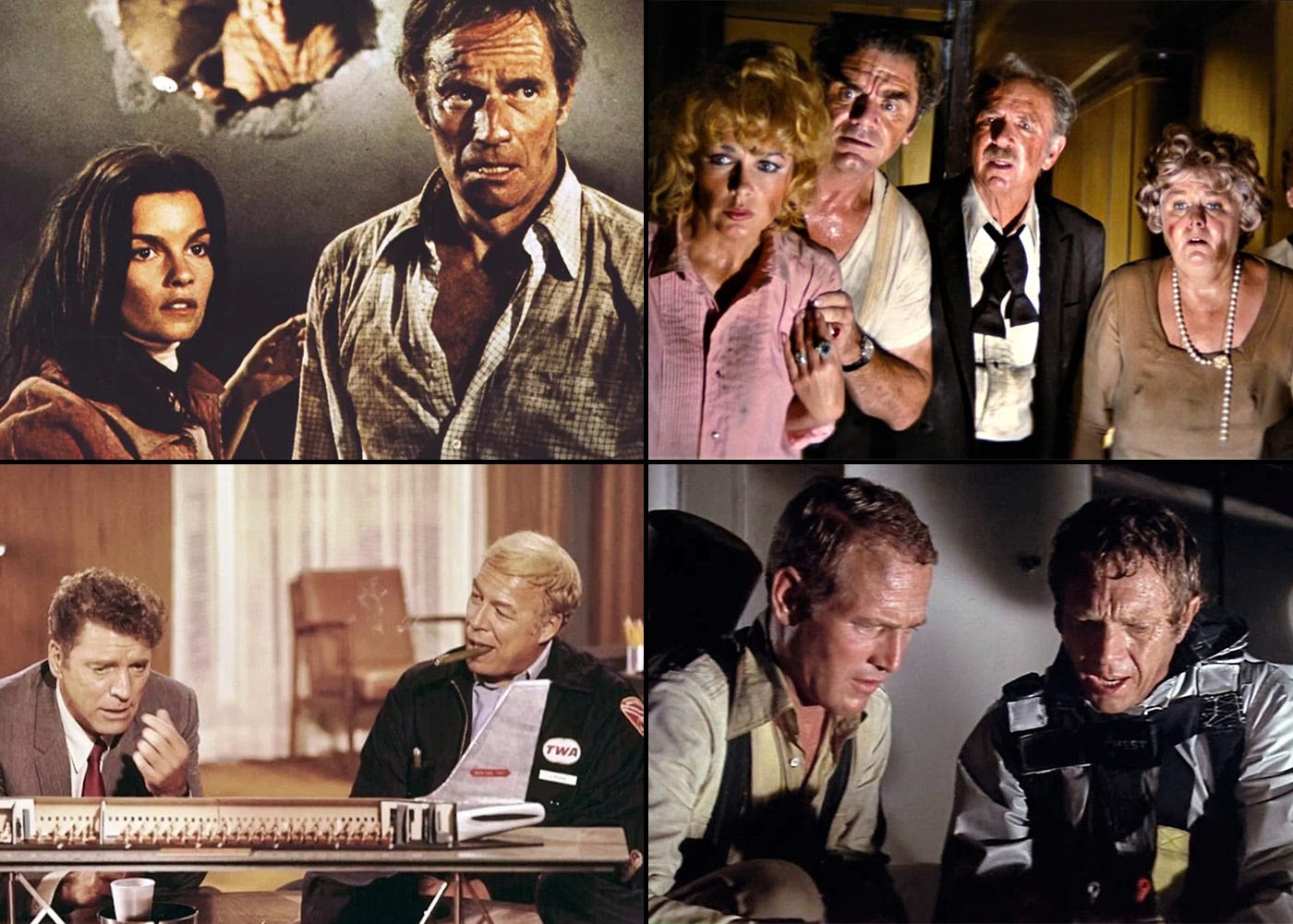
Airport (1970)
Set over one snowbound night at a busy Chicago airport, Airport weaves together multiple storylines, an overworked airport manager, a conflicted pilot, strained relationships, and a desperate man with a dangerous plan. The tension builds gradually, before the larger stakes take hold.
What makes Airport work so well is it’s scale. Burt Lancaster, Dean Martin, George Kennedy, Jean Seberg, Helen Hayes, the cast is stacked with faces you may not know by name, but absolutely recognize. The movie treats its ensemble seriously, letting each storyline unfold without feeling forced.
It was a massive hit, one of the earliest true “blockbusters,” and set the template the entire decade would follow: big casts, grounded storytelling, and high-stakes tension.
Earthquake (1974)
Earthquake promised exactly what it delivered: the complete destruction of Los Angeles.
Centered in Los Angeles, the film introduces a wide range of characters, before unleashing a catastrophic quake that tears the city apart. Once it hits, the movie becomes pure spectacle: collapsing buildings, massive destruction, and survival stories unfolding in real time.
At the center is Charlton Heston, bringing his signature intensity to a man caught between personal turmoil and unfolding disaster. Around him is a deep ensemble cast, including familiar faces like George Kennedy, Lorne Green and Ava Gardner.
Earthquake was create as an event, not just it a movie, it was a physical experience. The filmmakers pioneered the shaker mount camera system to simulate realistic movement, and introduced Sensurround, blasting sub-audible bass through giant speakers so powerful they made seats (and sometimes ceiling tiles) vibrate.
The stunt work is amazing: real falls, real debris, real crashes.
In the midst of all the destruction, the personal stories carry real weight, making the survival (or loss) of characters more emotional than expected. It’s pure disaster chaos.
The Poseidon Adventure (1972)
Set aboard a luxury ocean liner on New Year’s Eve, the movie quickly turns into a survival story when a rogue wave capsizes the ship. The survivors must navigate an upside-down world, climbing their way through the wreckage in hopes of escape.
Led by Gene Hackman as a determined and unconventional preacher, the movie leans heavily into character dynamics. Hackman, Ernest Borgnine, Shelley Winters, Jack Albertson, it’s another stacked cast, but no one is safe simply because they’re famous.
Relationships evolve, tensions flare, and every character has a purpose. The writing gives each person a distinct arc, making the journey feel and survival feel important. Add in a powerful score by John Williams, and you get one of the best disaster movies ever made.
The Towering Inferno (1974)
Set in the world’s tallest skyscraper during its grand opening, The Towering Inferno follows what happens when overlooked safety shortcuts turn into a full-scale catastrophe.
The film is powered by two Hollywood titans: Steve McQueen and Paul Newman. Their dynamicm, one a no-nonsense fire chief, the other the building’s architect, gives the film a strong emotional core amid the chaos.
The practical effects and stunt work are relentless: real fire, real smoke, real danger. You can feel the heat.
It’s also one of the best examples of the genre’s ensemble storytelling—multiple perspectives, intersecting arcs, and constant tension. And once again, John Williams’ score gives you a movie that is epic and intense.
These movies hold up today because of the disaster but also the story telling.
They take their time. They let you meet the characters, understand their relationships, and invest in their outcomes. So when disaster strikes, it actually matters. And there’s no guarantee of survival, not even for the biggest stars.
Long before the term “blockbuster” became standard (thanks to Jaws), these films were already defining what that meant.
No matter which of these you choose, you’re guaranteed a movie night that’s anything but a disaster.
Until next time — be kind, rewind.